MCK
You can define a 2-noded spring/damper element using the Spring element type, a 1-noded spring/damper element using the EarthSpring type, and a 1-noded concentrated mass using the PointMass type. These elements can have spring/damper properties or concentrated mass defined in any of the X, Y, Z, RX, RY, and RZ directions, as needed. All of these elements use the MCK section type, and each one can have its own material properties including a local coordinate system defined with *CoordinateSystem, TYPE=Orientation, and a scaling factor.
In the following example:
- Spring element 1001 has a spring constant of 10 in the X direction and 20 in the Y direction.
- Element 1002 adjusts the spring constants to 5 and 10 in the X and Y directions, respectively, by applying a scaling factor of 0.5.
- Element 1003 specifies a separate element coordinate system. If the element coordinate system is not specified, the Global Coordinate System (GCS) is used by default.
Example
*Section, Type=Spring, Name=springSection
 Spring, X, 10
 Spring, Y, 20.

*CoordinateSystem, TYPE=UCS, Name=springCS
 0,1,0, -1, 0, 0

*Element, Type=Spring, ELSet=sp
 1001, 1001, 1002, S=springSection
 1002, 1001, 1002, S=springSection, SF=0.5
 1003, 1002, 1003, S=springSection, CS=springCS
Example
*Node
 1001, 0,0,0

*Element, Type=PointMass, ELSet=pm
 1001, 1001

*Section, Type=MCK, Name=pmSec
 Mass, 100., 10., 10. 10 , # m, Ix, Iy, Iz, rx, ry, rz

*Distribution, TYPE=Section
 pm, pmSec
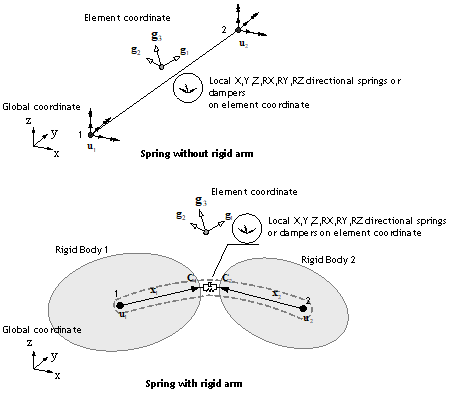
Fig. 4.8-1. Spring and Damper Elements
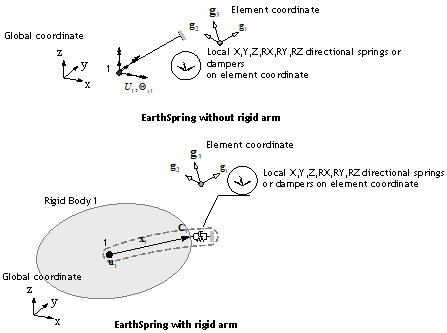
Fig. 4.8-2. EarthSpring Element
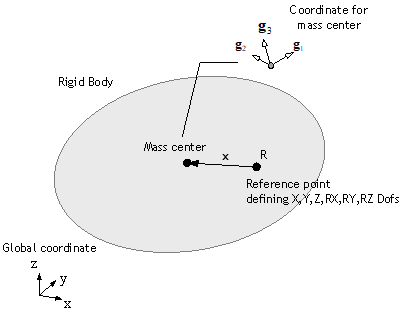
Fig. 4.8-3. PointMass Element
Sign Convention
For Spring and EarthSpring elements, the formulation is independent of the nodal coordinates of the connected nodes, so care must be taken in interpreting the signs of forces and deformations. Forces and deformations are determined based on the element's local coordinate system (ECS). If the ECS is not specified, it is the same as the global coordinate system (GCS). The following summarizes the sign convention for spring and damper elements.
(1) Spring Element
If no separate local coordinate system is defined (i.e., the local coordinate system is the same as the global coordinate system) and there is no rigid arm, the deformation is defined as the displacement difference between the end node and the start node (\(\delta = u_2 - u_1\)). For example, in a Spring element with a single spring in the X direction, the deformation is given as follows:
A positive value of \(\small\Delta U\) does not indicate tension but rather that the deformation at the end node is greater than at the start node. The sign of the force is interpreted similarly, and the same sign convention applies to the Damper element. Fig. 4.8-4 illustrates the sign convention for the Spring element. For a tension spring, a positive sign for both force and deformation indicates tension, and for a compression spring, a positive sign indicates compression.
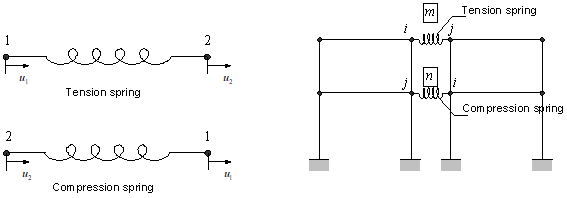
Fig. 4.8-4. Sign Convention for a Spring Element Without a Specified Local Coordinate System
If a separate local coordinate system is defined, the deformation is based on the local coordinate system.
For the EarthSpring element, if no separate local coordinate system is defined (i.e., the local coordinate system is the same as the global coordinate system) and there is no rigid arm, the deformation is defined as the displacement of the given node (\(\delta = u_1\)). For example, in an EarthSpring element with a single spring in the X direction, the deformation is given as follows:
In this case, a positive value of \(\small\Delta U\) does not indicate tension but rather that the connected node displacement is negative. The sign of the force is interpreted similarly. The same sign convention applies to the EarthDamper. Fig. 4.8-5 illustrates the sign convention for the EarthSpring element. For a tension spring, a positive sign for both force and deformation indicates tension, and for a compression spring, a positive sign indicates compression.
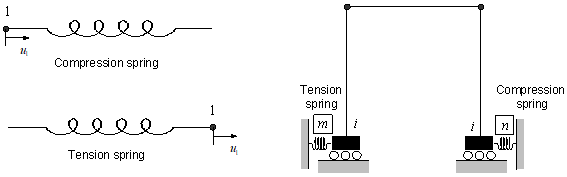
Fig. 4.8-5. Sign Convention for an EarthSpring Element Without a Specified Local Coordinate System
If a separate local coordinate system is defined, the deformation is based on the local coordinate system.
*Element, Type=Spring
*Element, Type=Spring, ELSet=elset
 id, n1, n2{, S=section, CS=cs, SF=sf}
 ...
Specifications
- No. of nodes: 2
- No. of integration pts.: 1
- Fields: SF=[...], SE=[...], DF=[...], DE=[...] at element center.
- Compatible section: MCK
- Active DOFs: Combination of X, Y, Z, RX, RY, RZ
- CS: ECS with the type of
*CoordinateSystem, TYPE=Orientation - SF: Scaling factor
SF refers to Spring Force, SE refers to Spring Deformation, DF refers to Damping Force, and DE refers to Damping Deformation Rate. The components are determined based on the active degrees of freedom. For example, for a spring using the Y and Z degrees of freedom, they are recorded in the order: SF=[SF.Y, SF.Z], SE=[SE.Y, SE.Z], and so on.
*Element, Type=EarthSpring
*Element, Type=Spring, ELSet=elset
 id, n1{, S=section, CS=cs, SF=sf}
 ...
Specifications
- No. of nodes: 1
- No. of integration points: 1
- Fields: SF=[...], SE=[...], DF=[...], DE=[...] at the element center.
- Compatible section: MCK
- Active DOFs: Combination of X, Y, Z, RX, RY, RZ
- CS: ECS with the type of
*CoordinateSystem, TYPE=Orientation - SF: Scaling factor
Refer to *Element, TYPE=Spring for explanations of SF, SE, DF,
*Element, Type=PointMass
Defines the cross-section for a concentrated mass element.
*Element, Type=PointMass, ELSet=elset
 id, n1{, S=section, CS=cs, SF=sf}
 ...
Specifications
- No. of nodes: 1
- No. of integration pts.: None
- Fields: None
- Compatible section: MCK
- Active DOFs: Combination of X, Y, Z, RX, RY, RZ
- CS: ECS with the type of
*CoordinateSystem, TYPE=Orientation - SF: Scaling factor
*Section, Type=MCK
Defines the cross-section for MCK elements such as Spring, EarthSpring, and PointMass.
*Section, Type=MCK, Name=name
 Spring, oneDof, coef|material
 ...
 Damper, oneDof, coef|material
 ...
 Mass, m,Ix,Iy,Iz
 UnitSystem, force-length-time
 xRigid1,yRigid1,zRigid1, xRigid2,yRigid2,zRigid2
First and subsequent data line starting with Spring
- oneDof: Degree of freedom to which the spring is applied; one of X, Y, Z, RX, RY, or RZ
- coef: Spring coefficient
- material: Reference material model used instead of the spring coefficient. Must support uniaxial material behavior
First and subsequent data line starting with Damper
- oneDof: Degree of freedom to which the dmaper is applied; one of X, Y, Z, RX, RY, or RZ
- coef: Damping coefficient
- material: Reference material model used instead of the damping coefficient. Must support uniaxial material behavior
First and subsequent data line if necessary – Spring|Damper line
- m, Ix, Iy, Iz: mass (required) and rotational inertia (optional, default 0,0,0)
Optional single UnitSystem data line
- force-length-time: The local unit system applied to this section. force must be one of N, kN, kgf, tonf, lbf, or kip; length must be one of m, cm, mm, km, in, ft, yd, or mi; and time must be one of s, min, hr, or day.
Optional last data line
- xRigid1,yRigid1,zRigid1: position vector from ref. node (rigid arm vector) (optional, default 0,0,0)
- xRigid2,yRigid2,zRigid2: position vector from ref. node (rigid arm vector) (optional, default 0,0,0)
Spring, Damper, Mass, and UnitSystem may be defined in any order, and Spring and Damper may be used multiple times depending on the DOF to which they are applied.
Spring or damping coefficients are generally defined as numerical values. However, when nonlinear behavior is to be represented, they may be defined by referencing a material that supports a uniaxial material model. For example, if a uniaxial material model is assigned to a Spring in the X direction, the stress–strain relation of that material is interpreted as a generalized force–displacement relation in the X direction. The same concept applies to rotational DOFs (RX, RY, RZ), in which case it is treated as a generalized moment–rotation relation.
- localUnitSystem is optional and is specified in the form of force-length-time, such as kN-mm-s. The force unit shall be one of N, kN, kgf, tonf, lbf, and kip; the length unit shall be one of m, cm, mm, km, in, ft, yd, and mi; and the time unit shall be one of s, min, hr, and day.
- If localUnitSystem is specified, the global UnitSystem shall have been defined in advance by
*Environment, TYPE=UnitSystem. - If localUnitSystem is not specified, the input for this Section follows the global UnitSystem defined by
*Environment, TYPE=UnitSystem. - localUnitSystem defines the unit system for coef or material used in this Section.
- If localUnitSystem is identical to the global UnitSystem, the input values are used directly without any additional scaling. If the two unit systems are different, appropriate unit conversion is performed internally. For example, if the global UnitSystem is kN-m-s and the localUnitSystem is kN-mm-s, and a material model is used for a Spring in the X direction, the displacement is converted from the m basis to the mm basis before evaluating the material model, and the generalized force computed by the material model is then converted back to the global UnitSystem and used in the analysis.
Example
*Section, Type=MCK, Name=springSection
 Spring, X, 10
 Spring, Y, 20.
 Damper, X, 5
 0,1,0, 0,2,0

*Section, Type=MCK, Name=springSection
 Mass, 100
 0,1,0, 0,2,0

*Environment, TYPE=UnitSystem
 kN-mm

*Material, TYPE=vonMises, Name=plas
 200
 4

*Section, TYPE=MCK, Name=NL
 Spring, X, plas
 UnitSystem, N-mm-s